🔥The Hidden Cost of the Grid
According to new research from 
Harvard University, eight million deaths annually are linked to toxic pollution from fossil fuels burned to power the world’s electric grid. These emissions are packed with dangerous particulates and over 50 harmful chemicals.  They don’t just cloud the skies. They damage the lungs, hearts, and futures of hundreds of millions.
Is it socially responsible to double or triple the health impact of this deadly energy source… just to charge the world's vehicles?  What kind of world do you want your grandchildren to inherit?

🛠️Kamtech seeks to build a Cleaner, Greener World!
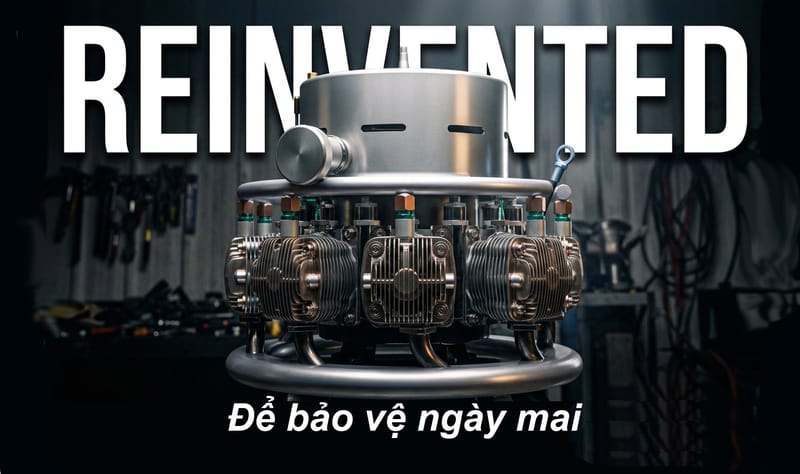
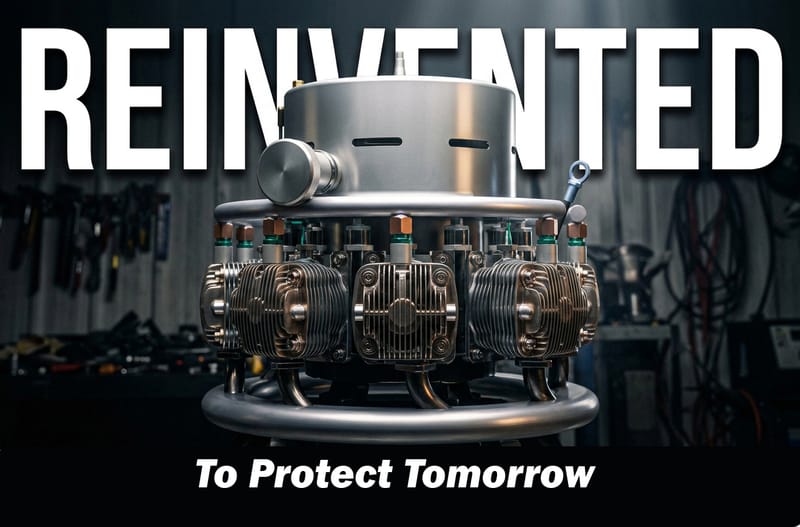
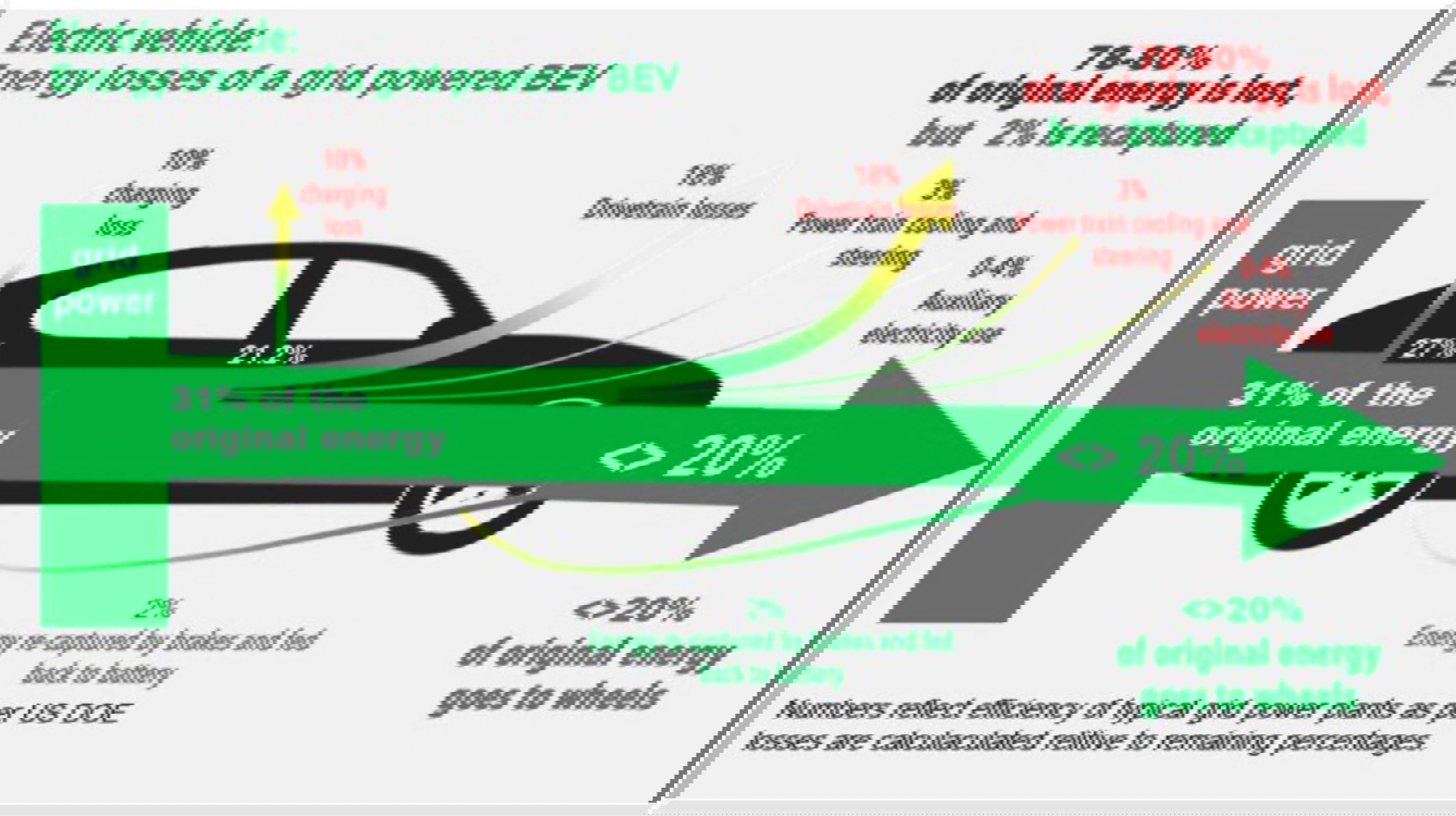
Electric vehicles powered by Kamtech’s On Board Energy system break the cycle. They no longer rely on coal- and petroleum-fueled power plants that spew toxic substances into the air and produce over 2/3 of the world's electric power.  Kamtech's OBE has,
  • No grid dependency
  • No indirect emissions
  • Virtually no harmful emissions. 
Kamtech’s vision is a world filled with clean EVs and healthy citizens. Let’s build that future—one vehicle at a time.
🟢 Help us make the world a better place to live.

    
On board energy is good for the world! imageOn board energy is good for the world! image


The next step in OBE 1 long journey.  imageThe next step in OBE 1 long journey.  image
💡 From Persistence to Breakthrough
“I have not failed. I've just found 1,000 ways that won't work.” —Thomas Edison

Every transformative technology passes through three phases: concept, development, and commercialization. For the 4-stroke automotive engine, this journey spanned 37 years—from 1861 to 1898—until the Benz Motorwagen became the first mass-produced car.

The development of Kamtech’s On Board Energy (OBE) system followed a similarly demanding path. Fueled by dedication, not full-time effort, our mission was clear: to conserve energy and build a cleaner, more peaceful world. 

Early Inspiration
In 1991, Jim Duncalf a former lecturer for the Illinois Department of Energy, came across an article on the 1925 "Fairchild Camenz Engine".  This inovative cam centered engine was simple and far more reliable than contempory radial engine which often failed after just 50 hours.  

However, its manually machined cam produced serious torsional vibration, which was too much the wood and fabric aircraft of the day.  Thirty five years later in 1960 the same Sherman Fairchild put together the team that developed the first silicon intergrated circuits, or computer chips, which eventually made possable technology that could machine precicion, made to order cam shapes with CNC machining.  Duncalf reasoned that the main issue with the radial cam concept, its poorly designed cam could now be solved with a well engineers cam produced by his engineering firm's CNC.  So he set out to build a team to make it happen.

Building Momentum
The Rad Cam's first supporter was Professor Antoni K. Oppenheim, who had outlined the need for a complete replacement of the Diesel/Otto cycle engines in a 1982 SAE paper.  He explained that the dynamic of the crank was a poor match for the dynamic of combustion and provided guidence for the project until his passing.  

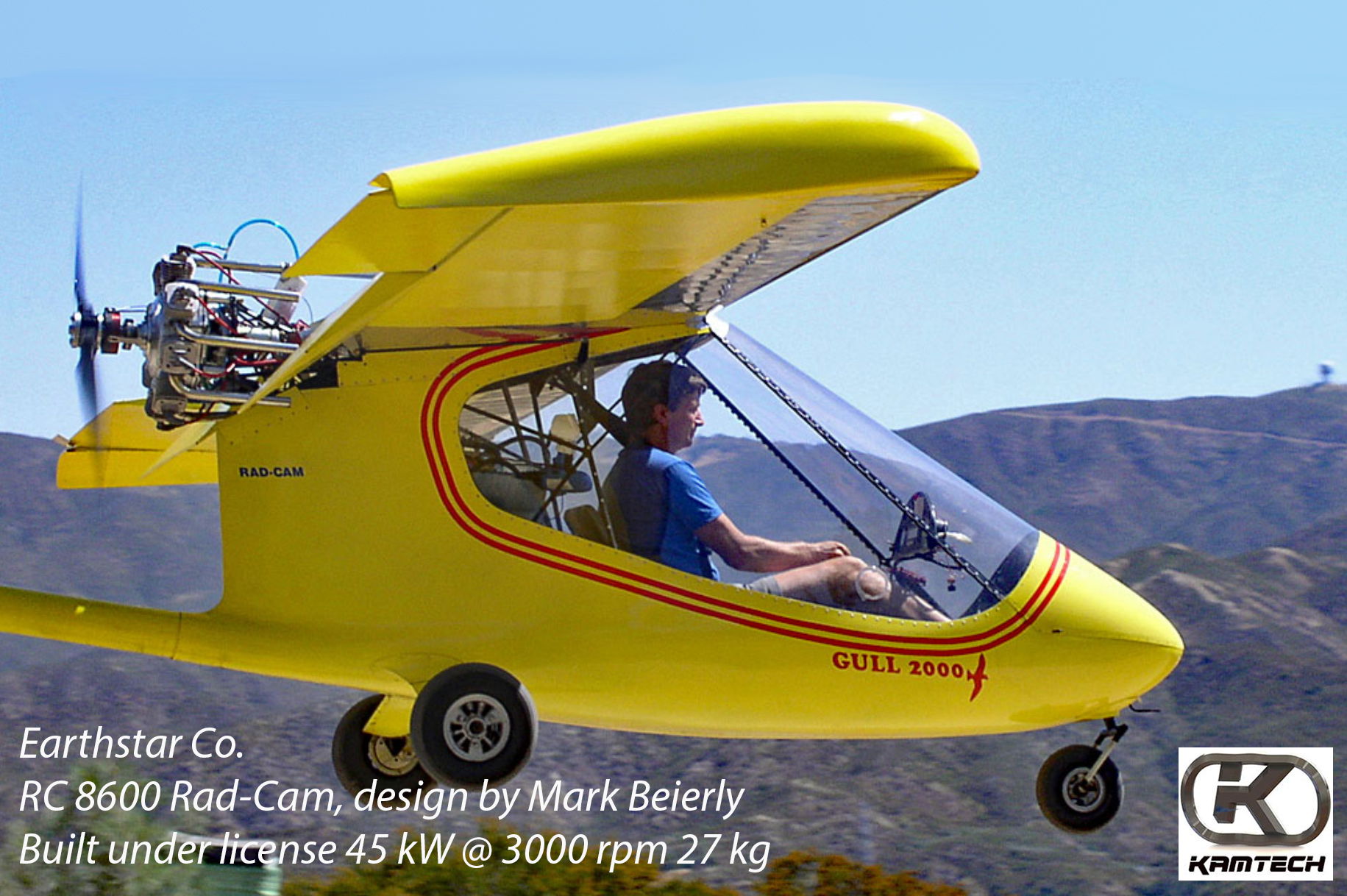
To shape the engine's layout and form, Duncalf held several brainstorming sessions with one of his childhood heros the famous mechanic Smokey Yunic.  By early 2001, Duncalf had designed and built two spatial prototyping of mechanical components.  A few months later Mark Beierle, whose small company, Earthstar Aircraft, became the first licensee.  Together they developed three generations of running prototypes, culminating in a production version is pictured on this site.  Armed with a working design, in 2006 we approached Mark Eberhard co-founder of Tesla about the use of the Rad Cam as a range extender in their future plans, Tesla was to reject the idea.  

A New Chapter in Vietnam
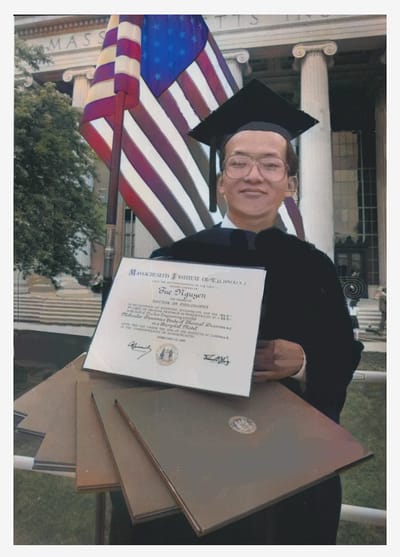
Momentum returned in 2012 when Vietnamese entrepreneur, Tue Nguyen, -- holder of over a hundred patents, and a world record for the number of degrees from the Massachusetts Institute of Technology--- offered to partner with Duncalf and fund Rad Cam development at his large manufacturing firm in District 9, Ho Chi Min City.  Unfortunately, after 14 months, his firm's aging machines failed to produce a single usable part.  

As the project seemed ready to close, young engineering student Phạm Duy Tùng and several friends encouraged Duncalf to keep the project in Vienam.  Shortly afterward, he met Professor Huynh Thanh Cong whose expertise and encouragement provided decisive. Professor Công advised on multiple engineering problems and inspired the team to persist.  History proves one truth: success is born from relentless iteration. 
 
 Ready for the Future
After years of redesigns, rebuilds, material changes and --- most recently --- several months of AI assisted refinements, we now have a production-ready design of the Rad Cam engine.  A compact, efficient power source that outperforms conventional 4-stroke engines in ease of manufacture, thermal efficiency, durability, and cost. 
The modular design that has been:
  • Proven in light aircraft
  • Adapted for electric vehicles
  • Refined through six prototype platforms and hundreds of modifications.
Kamtech's OBE 1 design is ready to reshape mobility. We’re seeking visionary partners to bring this breakthrough to market.

🔗 Join us in powering the future, on the road and beyond!


  • 21:04 Block E27 Belleza, Đ. Số 2, Phú Mỹ, Quận 7, Thành phố Hồ Chí Minh 700000

Professor Antoni K Oppenheim

The person who ignited the Rad Cam Revolution

Professor Antoni K. Oppenheim was more than a scientist—he was a visionary who reshaped the field of combustion engineering. His professional journey began in the 1940s, when he escaped war-torn Poland and contributed to advanced aircraft engine development in the UK. From the start, he tackled one of engineering’s greatest challenges: understanding the invisible interplay of flame fronts, pressure, and temperature inside the volatile chambers of internal combustion. While most accepted the limitations of the Otto cycle, Oppenheim saw its flaws clearly. He identified the hot flame front as the source of harmful NOx emissions, and the quenching layers as the cause of unburned hydrocarbons and CO. To him, solving these systemic issues—not masking them with catalytic converters or computer controls—was the true path to cleaner, more efficient combustion. Through groundbreaking research and influential publications, he offered solutions that challenged conventional thinking. Colleagues remember him as a quiet titan of innovation, always ready to provide multiple pathways forward when faced with complex problems. His insights became foundational to the design of the Earthstar Rad Cam engine, and ultimately shaped the development of Kamtech’s On Board Energy (OBE) unit. His legacy is profound. By liberating EVs from grid dependence and oversized batteries, Oppenheim’s influence continues to offer empowerment to manufacturers, drivers, and the future of transportation. Though deeply missed, his vision endures—illuminating the path toward independent, cleaner energy.

Smokey Yunick

Maveric of motion!

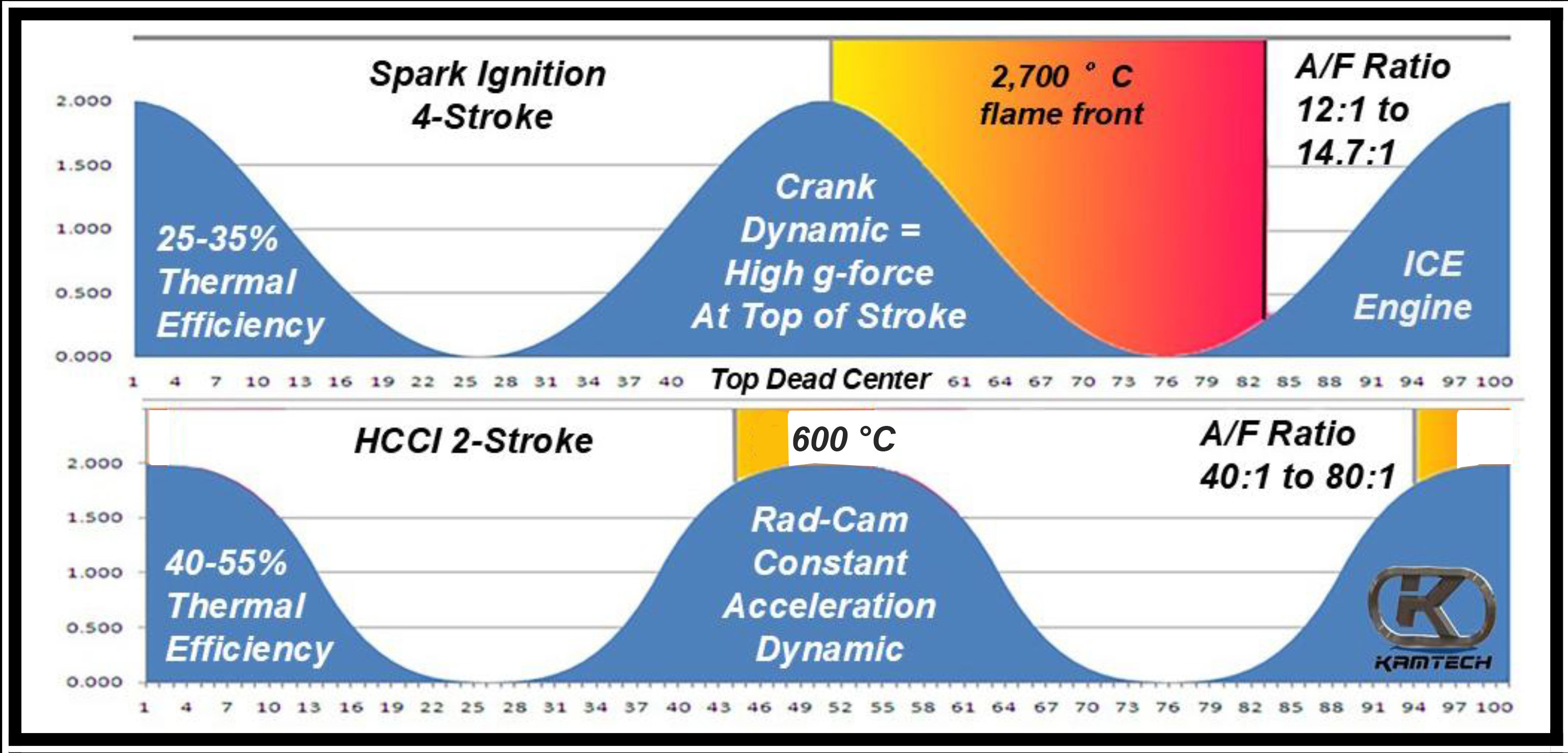
Smokey Yunick’s career was legendary, spanning groundbreaking work with Hudson, Ford, and General Motors. More than an innovator, Smokey was a force of nature—known for bold ideas and relentless pursuit of performance. In 1991, when Duncalf set out to design the “ideal engine,” he turned to Smokey for guidance. While Professor Oppenheim had spent his life defining what needed to change in combustion and its environment, Smokey was uniquely qualified to show how to make it happen. Within days of hearing Oppenheim’s challenge, Smokey delivered a transformative insight for the shape of the cam: a constant acceleration profile. This radical design reduced initial force while increasing dwell time at both ends of the stroke, unlocking new levels of power, efficiency, and durability. It not only proved to greatly increase the efficiency of the spark ignition two-stroke version, but also promises to make managing the HCCI version much easier to accomplish. Smokey’s obsession with reclaiming waste heat and improving fuel economy directly shaped the Rad Cam engine. His recommendations—such as stainless steel pistons and heads with insulated coatings—became integral to its internal cooling system of the final design. More than his technical brilliance, it was his fierce, unwavering belief in the project that inspired the team. As one colleague recalled: “When Smokey believed in you, you had no choice but to rise to it.”

Mark Beierle

Engine designer/builder

Mark Beierle, owner of Earthstar Aircraft Company, was the first licensee of the Rad Cam engine. Leading his team through multiple prototype iterations, he played a crucial role in refining the design. The final prototype—a production-ready version—provided undeniable proof that Professor Oppenheim’s theories on combustion dynamics, documented in his papers and books, were correct. Together, Duncalf, Yunick, and Beierle transformed Oppenheim’s concepts into a functioning engine with a thermal efficiency approaching 50%—a groundbreaking achievement in powertrain innovation. Beierle’s expertise in engine design, his relentless dedication to building and testing, and his determination to see the Rad Cam succeed were instrumental in turning it into a practical and efficient power source capable of revolutionizing the EV sector. Had the economic crisis of 2008 not disrupted funding opportunities just as he was seeking seed capital, the project may have moved forward at an even faster pace. His efforts proved the viability and robustness of the Rad Came engine and laid the groundwork for the development of Kamtech's OBE 1 design.


Prof. Huynh Thanh Cong - Copy

HCCI and Injection Consultant

In 2014, Professor Cong was teaching at the University of Science and Technology in District 10, Ho Chi Minh City, when he was first contacted by Jim Duncalf and Tung Pham. At that time, the company sponsoring the development and commercialization of the Rad Cam engine at their Ho Chi Minh plant lacked the talent, skills, and resources to carry the project forward. It was Professor Cong’s deep understanding, insight, and encouragement that convinced Mr. Duncalf to keep the Rad Cam project in Vietnam rather than relocating it elsewhere. Professor Cong is a recognized authority in fuel injection and compression combustion, with several published papers on internal combustion engines of various types. His expertise provided critical guidance in overcoming multiple engineering challenges, including resolving specialized material issues during prototype construction. Yet his most inspiring contribution was his observation of the similarity between the Rad Cam’s constant acceleration dynamics and the natural piston behavior in Free Piston Engines (FPE), where inertial forces dictate motion. In 2025, he authored a paper on how FPE dynamics could enhance the efficiency of two-stroke HCCI engines, and he even built and tested a prototype to validate his ideas. Through his technical acumen and steadfast support, Professor Cong helped solidify Vietnam’s role in the Rad Cam journey. His contributions remain embedded in Kamtech’s commitment to innovation, persistence, and the pursuit of engineering excellence.

Phạm Duy Tùng

Assembly Engineer

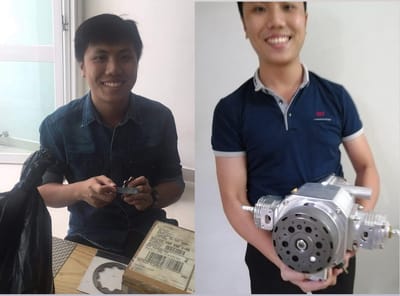
🚗 Phạm Duy Tùng has been with the project for over a decade. He made it possible to the design work to continue here in Vietnam. He has a background in advanced engine technologies, including hands-on experience with many of the industry’s most sophisticated engines. His contributions in the area of sourcing, adapting, and perfecting every component of the Rad Cam were invaluable to the project. Tùng is a vocal contributor in technical debates—his ideas, often grounded in obscure research or hard-won experience, steered the project clear of many problems. "Without Tùng’s tireless contribution, there would be no Kamtech OBE 1.”

D James Duncalf

Patent holder

Jim Duncalf has spent a lifetime searching for ways to conserve energy. As a spokesperson and lecturer for the Illinois Department of Energy, he spoke at universities, business gatherings, and energy expos. He lived through the 1973 OPEC Oil Embargo, witnessing firsthand the hardships, political tensions, and wars fueled by dependence on fossil energy. That experience shaped his conviction: while electric vehicles offer many benefits, plugging them into the world’s power grid is not the answer. ------------------------------------------------------------------------------------ Over the past two decades, the global utility sector has spent hundreds of millions lobbying for control of the automotive future. In many countries, laws were passed to force EV adoption through taxpayer subsidies — often benefiting wealthy buyers — and penalties levied against owners of petrol cars. Automakers, out of self‑preservation, poured billions into compliance. Yet the market remained unconvinced. Many manufacturers now stand on the brink of bankruptcy. By early 2025, a political backlash against grid‑powered EVs began in the United States and quickly spread internationally. As of 2026, several major automakers are planning or producing EVs with “range‑extender engines.” Ironically, most of these rely on designs first patented more than 160 years ago. Isn’t it time for EV companies to embrace twenty‑first century technology? Kamtech’s On‑Board Electricity (OBE) system is that technology. Compact, efficient, and designed for modern mobility, OBE delivers clean power without dependence on the grid. It represents a new chapter in energy innovation — one born from decades of persistence, hard lessons, and a vision for a sustainable future.